


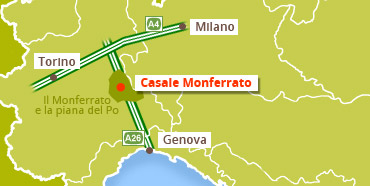
 Map
Map
Press Area
Casale, Valenza And The World Around: A General Look
MONFERRATO NOTES/
CASALE, VALENZA AND THE WORLD AROUND: A GENERAL LOOK
A little history Monferrato is a territory which emerged from the sea, from the Tethyde Ocean, twenty million years ago. There is no lack of evidence of a more recent past such as the Celtic necropolis which is being brought to light in recent years at Pobietto di Morano Po (between Casale and Turin), the remains of which constitute the nucleus of the archaeological section of the town Museum.
Densely populated since Roman times (the most important city was Vardacate), the territory underwent invasions of Barbarians, and then of Saracens (there are stories about a mythical treasure hidden in the caves of Moleto, in the Ottiglio area, Giarole was an Arab port on the Po). A little before the year one thousand, Aleramo obtained possession of the Monferrato seal (according to legend he was given as much land as could be contained within a horse ride lasting three days and three nights). From the period of the Aleramo family, to that of the Paleolo dominion with the state projected towards the East, the territory then passed under the control of the Gonzagas. The Monferrato residence was transformed by the dynasty of Mantua into a highly equipped defensive fort; the Po contributed to the defence on one side together with the castle whose structures were reinforced by Duke William; in the direction of the plains rose the impregnable Citadel with its six bastions (1590-95). For the whole of the sixteen hundreds, the Dukedom of Monferrato was at the centre of European history and … of wars and pillage, carried out by the great powers of the time, Spain and France, which fought each other for control of Casale and of its powerful hexagonal fortifications which nevertheless resisted numerous assaults (as remembered by Manzoni and more recently by Umberto Eco). Successively passing under the dominion of the Savoy dynasty (1713) Casale lost its role of capital city, but it was transformed, undergoing intense urban development works along some of the principal roads (via Mameli, via Garibaldi…) where the stupendous dwellings of the nobility were situated.
A quotation from Canon Gerolamo de Bono: “Monferrato, bountiful region of Italy, is enclosed between Liguria, Insubria and Piedmont … washed by the Tanaro and the Eridano, the king of rivers, the Stura, the Dora, the Bormida and the Tanaro … There are important cities, Casale di St Evasio, Acqui, Alba Nizza, Moncalvo and Trino and many noble boroughs and greatly fortified castles …” (1734, Origins of the church in the Casale area).
Notes Those who visit Casale today must not fail to go to see the Israelite complex (it is always open on Sundays, on other days if booked in advance) in Solomon Olper alley, with the baroque Synagogue and the museum, the second in Italy in this sector (it is also being enriched with a modern art section with works by Arman, Mondino, Luzzati, Recalcati, etc.) and the records with the Tolerances of Gonzago. Then (again in the centre) are the entrances to the cathedral dedicated to St Evasio (narthexes, hanging crucifixes, mosaics, treasures), the Church of St Domenico (with paintings by Guala and Musso, and with its cloister), St Philip’s (practically an art gallery itself), St Catherine’s (with splendid frescoes), St Michael’s (a little treasure with paintings by Caccia), the church of Jesus (with a wooden ceiling and valuable paintings), the Municipal Theatre (with a ceiling by Moja, and the royal box), the Gothic palace of Anna d’Alençon, the Renaissance palace of St George (used as the Town Hall), the palace of Magnocavalli, that of Gozzano di Treville, a baroque triumph, and that of Sannazzaro, the Holy Cross complex (with the civic museum and Leonardo Bistolfi’s very important gallery of plaster casts in the annex); one must also visit the main square, Piazza Mazzini, with its equestrian monument to the memory of King Charles Albert, and the Civic Tower (where visitors can climb to the top on the occasion of “Casale – Open City” every second weekend of the month, when there is also the antique market).
Not to be missed is a quick visit to Portinaro (via Lanza, just behind the central Piazza Mazzini, the ancient biscuit factory which produces the Krumiri biscuits)and a pause in the Savoy Caffè (Piazza Mazzini), with its warm and classic atmosphere of the Piedmontese tearooms of the end of the nineteenth century.
And it is lovely just to wander around the churches and the courtyards which represent a thousand years of the history of the capital city of the territory of the Marquises.
Here and there about Casale is still the capital of the Monferrato territory, a unique land with
the territory several symbolic townships: Vignale the town of dance; Cella Monte that of music (and, with Camagna, of the “infernot”, masterpieces of lesser art dug beneath the houses), Murisengo (and not only …) the town of truffles, Olivola that of jazz, Terruggia “country” town; Conzano the town of art and crafts, Rosignano the town of the Ghenza Valley wines, Villanova the town of rice, Borgo San Martino that of strawberries, Fubine that of asparagus, Villamiroglio of peas…
The Sacred Mount of Crea, in the heart (also the devotional heart) of the Monferrato territory is an oasis of art as well as a Regional Natural Park (with the basilica, 23 chapels and five hermitages).
In the other Natural Park at Valenza, that of the Garzaia (place of the egrets) which today also “looks towards” the Po and Orba, important didactic work is carried on.
Valenza, the capital of the art of jewellery creation, is joined to the Monferrato territory by the Po. Valenza rises on a terrace positioned on the Northern side of the extreme Eastern extensions of the Monferrato hills, and dominates the Po plain (it is 40 metres higher). Of extremely antique origin (the Fulvi Forum was named after the Roman consul who conquered the town) it belonged to the committee of Lomello and to the Marquises of Monferrato, until it rose to be a free borough, then passed into the sphere of control under the Dukedom of Milan. As of 1707 it belonged almost permanently to the Savoy family. It was an important stronghold. In the heart of the city stands the grandiose Cathedral dedicated to St Mary the Greater (S. Maria Maggiore). In front of the cathedral there is the very active Municipal Culture Centre, which deserves a visit for the interesting helicoidal structure of its staircase, a work by Piermassimo Stanchi of Valenza.
Just after the middle of the nineteenth century began the practice of the craft of goldsmithing, which later rose to the highest levels and made the name of the town become famous throughout the world. The active Association of Goldsmiths of Valenza organises numerous events.
PRESS RELEASE
Casale Monferrato, June 2013
For further information:
Mon.D.O. Press Office
15033 Casale Monferrato (AL)
www.monferrato.org