


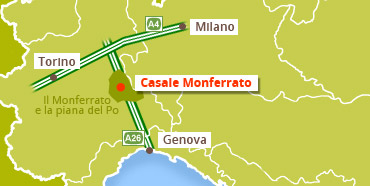
 Map
Map
Press Area
Monferrato, The Renaissance Of Quality Wines
MONFERRATO NOTES /A GREAT OENO - GASTRONOMY
MONFERRATO, THE RENAISSANCE OF QUALITY WINES
Throughout the centuries, the Monferrato territory has always been a land with a great wine-producing vocation.
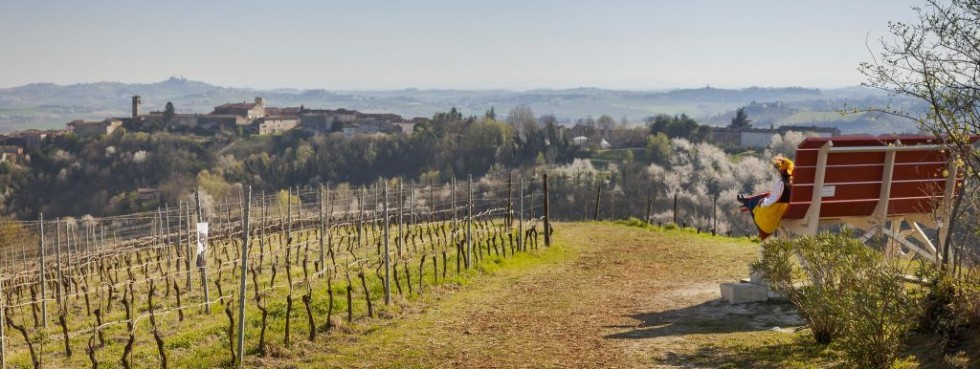
The social-economic events of history in the second half of the nineteen hundreds brought about a progressive depopulation and impoverishment of the rural patrimony. But over the last twenty years there has been a strong reverse tendency, and the Monferrato area has returned to live again like a great garden of vineyards.
The business abilities and the tenaciousness of the vine cultivators have permitted the recreation of the optimum conditions for a high level production, which today takes the names of the Monferrato wines onto the scenario of even the extra-European wine markets. Ranging from the great local vines, first of them all Barbera (which has applied for docg status - denominazione d’origine controllata e garantita: denomination of controlled and guaranteed origin), but also the typical Grignolino, anarchic and individualistic (as defined by Veronelli …), Freisa, Malvasia, to the important white wines like Chardonnay, the vine-producing Monferrato offers a wide and qualitatively important range in which the guest can soar, in an interesting and satisfying research even for the most demanding palates.
Beside the historic firms with excellent production, in the last half-century some lively cooperative wine cellars which bottle large quantities of wine have established themselves.
The Regional Wine Company at the prestigious “Castello del Monferrato” Casale Monferrato offers
a selection of the best wines and grappas of Piedmont; the samples are approved every year by a special tasting commission.
Many Monferrato producers, next to their firms, have created ‘Botteghe del vino’ (shops which offer the producer’s wine for tasting and for sale), and the practice of agro-tourism is becoming ever more strongly affirmed, as regards both the offer of good food and also for hospitality over several days. The “Open Cellars” exhibition (at the end of May) is a correct exaltation of the products and of this still uncontaminated territory.
For several years the Casale Town Council has held the wine competition, ‘Il Torchio d’oro’ (the golden Press) which awards prizes to the wines of quality.
GASTRONOMY: RECIPES, ANECDOTES AND CURIOSITIES
The cooking of Casale Monferrato is a combination of simple recipes together with more elaborate ones. For convenience they can be divided into two sections, those of the plains and those of the hill country. In the first, a remnant from the days of country poverty, single course meals are prevalent, like agnolotti (in the dough of the Casale agnolotti, according to the recipe of Francesco Caire, you should add a slice of ham and half a cabbage, while in that of Cerrina, apart from the ham, cooked salame and rabbit meat should also be added, and in the agnolotti of Fubine, “coppa” i.e. lean salame made from the meat of the neck of the pig, and brains should be added) and mixed fry (veal chops, escallops, liver, brain, pork, sausage, crispy chicken pieces, crisp apples slices, almond biscuits, sweet semolina … , in the villages beyond the Po frogs are also added), consisting of 11 pieces at the very minimum.
Another typical dish is boiled beef in three sauces (Moncalvo is the capital of boiled beef); on the plains, typical dishes are sliced meats (salam dla duju), marinated raw fish, rice and beans (known as “la panissa”), frogs (in risotto, fried in batter, … ), snails. According to the season, mushrooms and truffles are available. Hors d’oevres include sweet peppers in “bagna cauda” (a hot sauce made of oil and garlic), and “Bela Rusin” eggs (the Beautiful Rosy, common law wife of King Emanuel II, was born in Moncalvo).
A first course worthy of mention is gnocchi alla monferrina (Monferrato style potato and flour balls in sauce). Among the dishes which are cheap but by no means less tasty for it, the bagna cauda stands out, a sauce eaten with cardoons and other vegetables (Jerusalem artichokes, celery, sweet peppers, cabbage, radishes, potatoes … ) and particularly inviting to the conviviality is the ritual according to which all diners dip their vegetables into a single bowl in the centre of the table, in which the sauce is kept hot by means of a small stove on which it stands. Some dishes have disappeared, or almost, such as the finanziera (the customs officer’s dish), the soma (the load), broiled eel, the friciulin (pancakes) made with nettles or with vegetables and rice. There still are (fortunately) a thousand different ways of cooking chickens, rabbits, geese (and here there are connections with Hebrew traditions).
With regard to sweet things the krumiri must be mentioned at once (sweet biscuits with a lumpy surface made with white flour and maize flour, eggs, butter, sugar, vanilla and other flavourings), the strange shape of which reminded people of Victor Emanuel’s moustache, and which have become the symbol of Casale; then there is bunet (a chocolate egg custard with almond biscuit chips), cooked cream, fruit tarts, St Joseph pancakes; at Carnival time there are the gale (Caire’s recipe includes rum and vermouth and ends up with white wine). On St Evasio’s day the religious confraternity of the same name distribute their dry pastry biscuits (which are considerably sought after). In the area of Valenza the “Margherita” Amaretti (Margaret’s almond biscuits) are particularly well known and appreciated.
PRESS RELEASE
Casale Monferrato, June 2013
For further information:
Mon.D.O. Press Office
Via XX Settembre 7
15033 Casale Monferrato (AL)
www.monferrato.org