


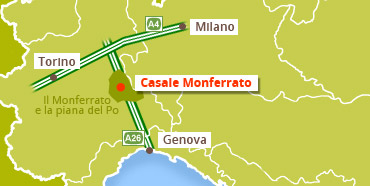
 Map
Map
Paths Through The Monferrato Countryside
MONFERRATO NOTES/
PATHS THROUGH THE MONFERRATO COUNTRYSIDE
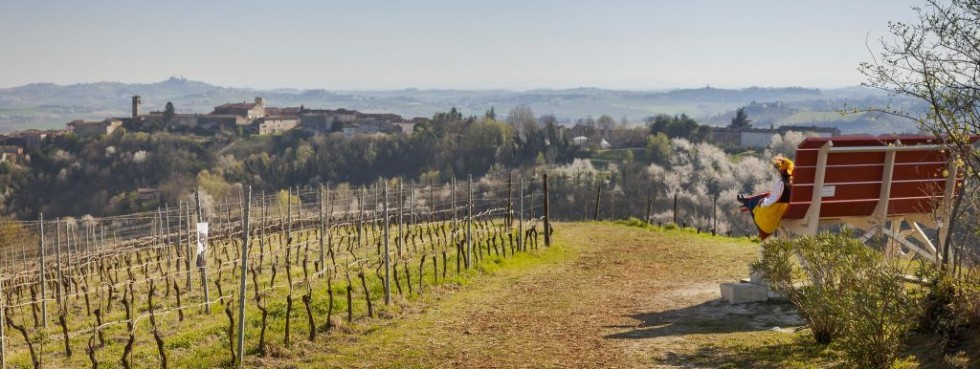
The Monferrato territory can be compared to a “sea of hills”, a maze of valleys and moderately high hills, called “bric e foss” (peaks and dales) by the DOC Monferrinos (the people of the Monferrato territory whose “denomination of origin is checked”, i.e. guaranteed genuine local people). Walking and travelling through this territory is like being immersed in the “sea” and to swim in it freely gives you a fantastic sensation of freedom: when you are on the top of a hill you immediately want to reach the top of the one in front of you, when you walk in a valley you are attracted by the wood situated a little above you, when you walk in a vineyard you would like to run through it to see what is beyond, and when in autumn the hills are ablaze with colour you would like time to stand still…
These are the unexpected emotions Monferrato gives you, when you travel through on foot, by bicycle, on horseback or by car. And yet, if the principle of moving is represented by walking from one point to another, when we talk of the Monferrato paths we cannot avoid underlining the importance of “staying”, of stopping at certain points to observe with an attentive eye the weft of the landscape around us, to take it in, to understand it, to take possession of its rules and reasons … The attentive gaze “breaks up the territory into little pieces” in order to appreciate the whole comprehensively.
The Monferrato landscape, in fact, can be essentially divided into three parts:
- the plains area, from Trino to Casale and Valenza, characterised by the rice fields and by the splendid hydraulic installations which carry the precious water from the canals to the streams in order to permit the rice to sprout. These are works originating hundreds of years ago, projected specifically for the territory, capable of exploiting the least inclination of a plain which is otherwise completely flat, which are a reminder of the efforts and of the intelligent manual abilities of the farmers. These areas, with abundant water and with a particular fauna (egrets, herons, storks, frogs, toads and fish) are spectacular, especially in April and May when the rice fields are flooded.
- the hill country, the heart of the Monferrato territory, with its gentle slopes where the vine dominates. Since Roman times, Pliny the elder spoke of the “muscum” grapes of these areas (the present day Moscato), telling of how the wine was particularly appreciated. The wisdom of the vine farmers can still be observed today, in the many ancient vineyards expertly situated following the curves of the hillside at a constant level, in the positioning called “girapoggio” (circling around the hillside below the castle on top maintaining a constant altitude) and in the terracing, which impose a certain geometry and an impeccable order on the landscape. And yet the farmer says “I want to make a good wine”, not “I want to make nice vineyard …” Production is the primary aim of the cultivation of the vine, and there is no aesthetic reason whatsoever: this is why in the Monferrato territory wines are produced which are unique throughout the world, but it is also why the landscape remains an example of the unique and genuine character of local history because it has remained unchanged for centuries.
- the wooded areas, now numerous on the higher hillsides and the cause of a gradual abandoning of the steeper slopes. They are rich woods full of chestnuts, ashes, bay oaks, “pessre” (Scotch firs), and of animals like foxes, hares, buzzards, pigeons … They are enchanted woods, with no dangers, perfect for long walks in the cool shade on the hottest summer days.
However, if we stop a moment more, when we are walking through the Monferrato valleys, not only does each particular landscape transmit a precise message to us, but also the path itself along which we are travelling tells us something. The first basic action that a man carries out when he wants to take possession of a place is to travel through it. In ancient times, the most primitive and spontaneous paths were those which followed the ridges, which went along the watersheds, far from the water courses, with greater visual control of the “marshy” areas in the bottom of the valleys … and still today the most used paths are those along the crests, because they are the oldest and the most stable. Little by little man began to individuate the paths to be followed across the hillsides, towards the valleys and finally to use the more easily reached valley floors.
After travelling through a territory, man must then settle it and build his dwelling there: way back in history, the crests were always preferred because they were safer from possible attack from outsiders and less exposed to the danger of erosion, being situated on the hilltops. Villages were also built, however, on the hillsides in more sheltered positions where the settlements would be less exposed to the winds. The settlements on the valley floors, instead, are relatively recent.
In any case, the landscape must be experienced in its entirety and it is just the complexity and the richness of the hills which make the Monferrato territory a unique and unforgettable environment, to live and to recount, to listen to and to smell, to see and to taste.
PRESS RELEASE
Casale Monferrato, June 2013
For further information:
Mon.D.O. Press Office
Via XX Settembre 7
15033 Casale Monferrato (AL)
www.monferrato.org